This tool is useful for students, fitness users, cooks, shippers, teachers, and anyone who needs fast unit conversion. Use it when you need to convert kg to lbs, pounds to kilograms, grams to ounces, pounds to stone, tons to pounds, or other everyday mass and weight units.
Quick Answer
The Weight and Mass Units Converter changes a value from one weight or mass unit into another. It supports common metric and imperial conversions such as kilograms to pounds, pounds to kilograms, grams to ounces, grams to pounds, ounces to kilograms, pounds to stone, and tons to pounds.
Enter your value, select the conversion type, and press the convert button. The tool shows the result and the formula used, which makes it helpful for quick answers, learning, checking homework, cooking, fitness tracking, and shipping calculations.
What Is This Weight and Mass Units Converter?
This Weight and Mass Units Converter is an online mass conversion calculator that converts values between commonly used weight and mass units. It helps you calculate, compare, and understand measurements without memorizing every formula.
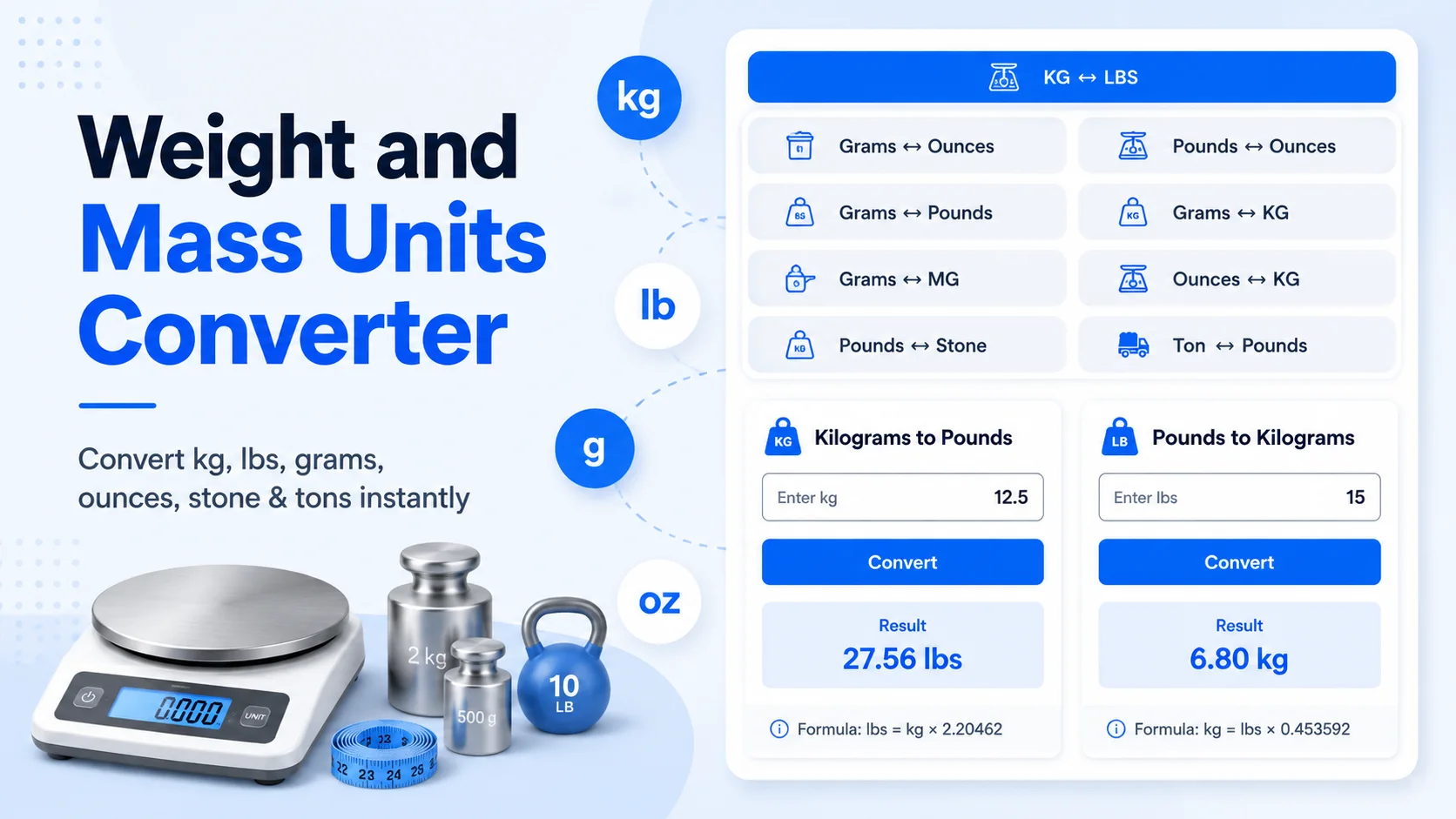
The tool supports popular conversions between metric units and imperial units. Based on the visible tool interface, users can switch between conversion options such as KG ↔ LBS, Grams ↔ Ounces, Pounds ↔ Ounces, Grams ↔ Pounds, Grams ↔ KG, Grams ↔ MG, Ounces ↔ KG, Pounds ↔ Stone, and Ton ↔ Pounds.
The page also shows individual conversion cards. For example, the screenshot includes a Kilograms to Pounds card with an input field labeled “Enter kg,” a blue Convert button, a result area showing pounds, and a formula line. It also includes a Pounds to Kilograms card with an input field labeled “Enter lbs,” a convert button, a kilogram result area, and the formula used.
How to Use the Weight and Mass Units Converter
Using this weight unit converter is simple. You do not need advanced math skills or a conversion table. Follow these steps:
Step 1: Select the Conversion Type
Choose the unit pair you want to convert. The visible options include KG to LBS, grams to ounces, pounds to ounces, grams to pounds, grams to KG, grams to MG, ounces to KG, pounds to stone, and ton to pounds.
Step 2: Enter Your Value
Type the number into the correct input field. For example, use the “Enter kg” field for kilograms to pounds, or the “Enter lbs” field for pounds to kilograms.
Step 3: Click the Convert Button
Press the blue Convert button. The tool calculates the converted value using the selected formula.
Step 4: Read the Result
The result appears in the result box below the button. For example, a kilograms to pounds conversion displays the answer in lbs, while a pounds to kilograms conversion displays the answer in kg.
Step 5: Check the Formula
The formula area helps you understand how the result was calculated. This is useful for students, teachers, and anyone who wants to learn how to convert units of weight and mass manually.
Key Features of the Mass Unit Converter
Multiple Weight and Mass Conversions
The tool includes several common conversion types in one place. You can convert metric units of mass such as grams, kilograms, and milligrams, as well as imperial and customary units such as pounds, ounces, stone, and tons.
Simple Input Fields
Each conversion card has a clear input box. Labels such as “Enter kg” and “Enter lbs” make it easy to know which value to type.
One-Click Conversion
The blue convert button gives users a clear action. This helps reduce confusion and makes the tool easy for beginners.
Clear Result Box
The result appears in a dedicated output area. This makes it easy to read the converted value without searching through extra text.
Formula Display
The formula line shows how the calculation works. For example, the kilograms to pounds card shows the formula for converting kg to lbs, while the pounds to kilograms card shows the formula for converting lbs to kg.
Metric and Imperial Support
The tool helps users convert between metric and imperial units. This is useful when measurements come from different countries, product labels, recipes, fitness apps, shipping forms, or school assignments.
Why Use This Weight and Mass Units Converter?
Manual unit conversion can be slow and easy to get wrong, especially when you move between metric and imperial systems. A weight conversion calculator saves time by doing the calculation for you.
This tool is especially helpful when you need quick conversions for everyday tasks. You can convert kg to pounds for body weight, grams to ounces for recipes, pounds to ounces for packaging, grams to milligrams for small measurements, and pounds to stone for UK-style weight values.
It also helps improve clarity. Instead of guessing whether a value is in kilograms, pounds, grams, or ounces, you can convert the number and compare it in a unit you understand.
Common Weight and Mass Conversion Formulas
The formulas below explain how common conversions work. The tool applies these formulas automatically, but understanding them can help you check answers and learn how to convert units of mass.
- Kilograms to Pounds: lbs = kg × 2.20462
- Pounds to Kilograms: kg = lbs × 0.453592
- Grams to Kilograms: kg = g ÷ 1000
- Kilograms to Grams: g = kg × 1000
- Grams to Milligrams: mg = g × 1000
- Pounds to Ounces: oz = lb × 16
- Ounces to Pounds: lb = oz ÷ 16
- Stone to Pounds: lb = st × 14
- Short Tons to Pounds: lb = ton × 2000
Practical Example
Suppose you have a package that weighs 12 kilograms, but the shipping form asks for the weight in pounds. Instead of doing the calculation manually, open the KG to LBS converter, enter 12 in the kg field, and click Convert.
The formula is lbs = kg × 2.20462.
So, 12 kg × 2.20462 = 26.45544 lbs. The package weighs about 26.46 pounds. This makes the result easier to use on shipping labels, courier forms, or product listings.
Who Can Use This Tool?
This converter is useful for many everyday and educational needs.
Students and Teachers
Students can use it to learn converting mass units, check homework, and understand formulas. Teachers can use it as a quick classroom reference for metric and imperial conversions.
Fitness and Health Users
People tracking body weight, gym plates, or fitness goals can convert kilograms to pounds or pounds to kilograms quickly.
Home Cooks and Bakers
Recipes often use different measurement systems. This tool helps convert grams to ounces, ounces to grams, pounds to ounces, and kilograms to grams.
Shipping and Ecommerce Users
Online sellers and logistics users can convert package weights between kilograms, pounds, ounces, and tons for product listings and shipping forms.
General Users
Anyone who sees a weight value in an unfamiliar unit can use this tool to convert it into a unit they understand.
Common Mistakes to Avoid When Converting Weight and Mass Units
Mixing Up Pounds and Ounces
Pounds and ounces are both imperial weight units, but they are not the same. One pound equals 16 ounces. Always choose the correct conversion option before entering your value.
Using the Wrong Direction
KG to LBS and LBS to KG use different formulas. If you choose the wrong direction, the answer will be incorrect. Check the conversion title before clicking convert.
Forgetting Decimal Values
Many conversions produce decimal results. For example, kilograms to pounds often gives a decimal answer. Avoid rounding too early if you need a more precise result.
Confusing Mass With Force
In everyday use, people often say weight and mass together. This tool is for common unit conversion, not advanced force calculations. It does not calculate gravitational force or Newtons unless such a feature is added separately.
Entering Units Inside the Number Field
Type only the number in the input field. For example, enter “25” instead of “25 kg” unless the tool specifically allows unit text.
Helpful Tips for Better Results
Use the conversion option that matches your exact need. For example, use grams to milligrams for very small metric values and pounds to ounces for smaller imperial package weights.
Check the formula under the result if you want to understand the calculation. This is helpful when learning how to convert metric units of mass or when checking schoolwork.
Keep the original value nearby if the conversion is important. This makes it easier to compare the original and converted values.
Use enough decimal places for precise tasks. For casual use, rounding is usually fine. For school, recipes, product weights, or shipping, use the level of precision required by your task.
Limitations of the Weight and Mass Units Converter
This tool provides quick unit conversions based on standard formulas. The result depends on the number you enter and the conversion option you select.
The converter is not a substitute for certified weighing equipment. If you need an official weight for trade, shipping compliance, laboratory work, or regulated documents, use a calibrated scale and follow the required rules for your use case.
The tool is designed for common weight and mass units. It is not intended for unrelated conversions such as mass flow rate, mass density, molar mass, atomic mass units, energy conversion, or volume-to-mass conversion unless those options are added as separate tools.
For tons, make sure you understand which ton is being used. Many everyday converters use the short ton, where 1 ton = 2000 pounds. Other ton types may differ.
Quick Weight Unit Conversion Table
Use this table as a simple reference for common conversions:
| From | To | Formula |
|---|---|---|
| 1 kilogram | Pounds | 1 kg × 2.20462 = 2.20462 lbs |
| 1 pound | Kilograms | 1 lb × 0.453592 = 0.453592 kg |
| 1 kilogram | Grams | 1 kg × 1000 = 1000 g |
| 1 gram | Milligrams | 1 g × 1000 = 1000 mg |
| 1 pound | Ounces | 1 lb × 16 = 16 oz |
| 1 stone | Pounds | 1 st × 14 = 14 lb |
| 1 short ton | Pounds | 1 ton × 2000 = 2000 lb |
Conclusion
The Weight and Mass Units Converter is a practical tool for converting common units such as kilograms, pounds, grams, ounces, milligrams, stone, and tons. It helps you avoid manual calculation errors, understand formulas, and get quick answers for everyday use.
Whether you are checking homework, converting recipe measurements, comparing body weight, preparing package details, or learning how to convert units of mass, this tool gives you a simple way to get the result you need. Enter your value, choose the right conversion, and use the answer with confidence.
FAQs
What is a Weight and Mass Units Converter?
A Weight and Mass Units Converter is an online tool that converts a value from one weight or mass unit to another. It can help convert kg to lbs, lbs to kg, grams to ounces, pounds to ounces, grams to milligrams, and more.
How do I convert kilograms to pounds?
To convert kilograms to pounds, multiply the kilogram value by 2.20462. For example, 10 kg equals 22.0462 lbs. You can also enter the value in the KG to LBS converter and click convert.
How do I convert pounds to kilograms?
To convert pounds to kilograms, multiply the pound value by 0.453592. For example, 20 lbs equals about 9.07184 kg. The pounds to kilograms tool uses this formula automatically.
Can I convert grams to mass units like kilograms and milligrams?
Yes. You can convert grams to kilograms by dividing by 1000, and grams to milligrams by multiplying by 1000. This is useful for metric mass conversion in school, cooking, and general measurement tasks.
Is this mass conversion calculator accurate?
The calculator uses standard conversion formulas for common units. Accuracy depends on entering the correct number and selecting the right conversion type. For official measurements, use a calibrated scale.
What is the difference between mass and weight?
Mass is the amount of matter in an object, while weight is the force caused by gravity. In everyday conversions, people often use weight and mass units together, such as kilograms, pounds, grams, and ounces.
Can this tool convert atomic mass units or mass flow rate?
No, this page is focused on common weight and mass unit conversion. Atomic mass units, molar mass, mass density, mass flow rate, and mass-to-energy conversions are specialized topics and should be handled by dedicated calculators.
Useful Weight, Health & Material Conversion Tools
If you are using the Weight and Mass Units Converter, these related tools can help with body weight, dosage calculations, material estimates, and recipe measurements.
- Water Intake Calculator – useful for estimating daily hydration needs based on body weight.
- Accutane Dosage Calculator – helpful for body-weight-based dosage calculations.
- Asphalt Calculator – estimate material needs for paving, driveway, and construction-style projects.
- Recipe Converter – adjust ingredient amounts and kitchen measurements for cooking and baking.