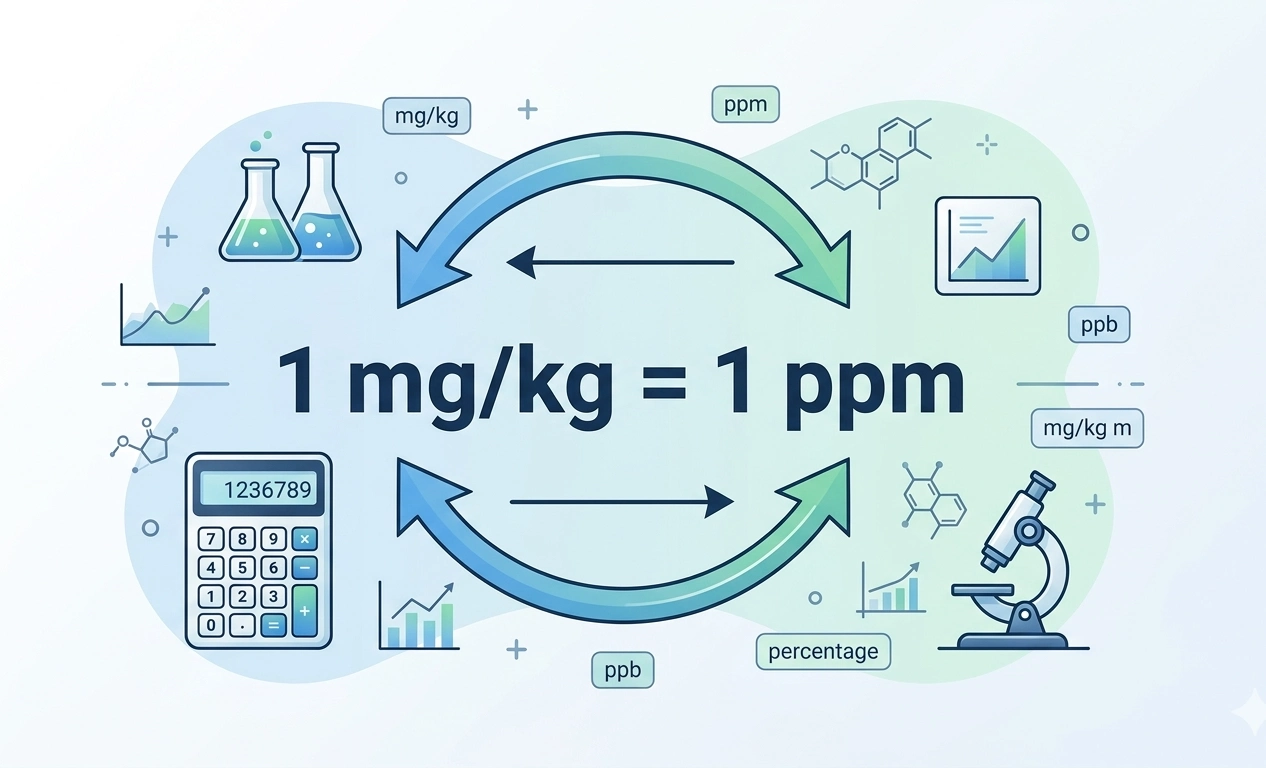
This simple relationship works because one kilogram contains one million milligrams. However, the 1:1 rule applies specifically to mass-based concentrations. Before converting a laboratory result, product specification, soil report, or food-testing value, check whether ppm means parts per million by mass.
Quick Answer: How Do You Convert mg/kg to ppm?
For a mass-by-mass concentration, use this formula:
ppm = mg/kg
Therefore, 1 mg/kg = 1 ppm.
The number stays unchanged. A concentration of 25 mg/kg is 25 ppm, while 0.01 mg/kg is 0.01 ppm. This direct conversion should not automatically be used for gases, volume-based ppm, medical doses, or liquid concentrations expressed in mg/L.
What Do mg/kg and ppm Mean?
Although mg/kg and ppm often show the same number, understanding what each unit represents helps prevent mistakes when working with different types of measurements.
What Does mg/kg Mean?
The abbreviation mg/kg means milligrams per kilogram. It states how many milligrams of a substance are present in one kilogram of the complete sample or material.
For example, if a soil test reports 8 mg/kg of a metal, each kilogram of the tested soil contains 8 milligrams of that metal. The unit is commonly used for solids and other measurements reported on a mass-per-mass basis.
What Does ppm Mean?
ppm means parts per million. One ppm represents one part of a substance in one million equal parts of the complete mixture.
The phrase “parts per million” does not always identify whether those parts are measured by mass, volume, or amount of substance. That is why the measurement basis should be checked before treating ppm as identical to another unit.
Is mg/kg the Same as ppm?
Yes, mg/kg and ppm are numerically equal when both describe a mass fraction. In that context, 1 mg/kg is exactly equal to 1 ppm.
The relationship follows directly from the metric definition of a kilogram:
1 kilogram = 1,000,000 milligrams
1 mg/kg = 1 mg ÷ 1,000,000 mg
1 mg/kg = 1 part per million = 1 ppm
In other words, one milligram within one kilogram represents one part of substance in one million parts of total material.
mg/kg to ppm Conversion Formula
Use the following formula when ppm is being used as a mass-based concentration:
Concentration in ppm = Concentration in mg/kg
Because the conversion factor is one, you do not need to multiply or divide the original value.
For example:
Given value: 35 mg/kg
ppm = 35
Answer: 35 mg/kg = 35 ppm
How to Convert mg/kg to ppm Step by Step
- Confirm the measurement basis. Make sure the value is a concentration by mass, such as milligrams of a substance per kilogram of material.
- Write down the mg/kg value. Keep the original decimal places and significant figures shown in the report.
- Use the 1:1 relationship. Replace the unit mg/kg with ppm without changing the number.
- Check the context. Confirm that the ppm result is also intended to represent a mass fraction.
Suppose a food-testing report lists a residue concentration of 2.5 mg/kg. On a mass basis, the equivalent concentration is 2.5 ppm.
Worked mg/kg to ppm Examples
Example 1: Convert 0.1 mg/kg to ppm
ppm = mg/kg
0.1 mg/kg = 0.1 ppm
The decimal does not move because the conversion factor is one.
Example 2: Convert 5 mg/kg to ppm
ppm = 5
5 mg/kg = 5 ppm
Example 3: Convert 10 mg/kg to ppm
ppm = 10
10 mg/kg = 10 ppm
Example 4: Convert 50 mg/kg to ppm
ppm = 50
50 mg/kg = 50 ppm
Example 5: Convert 1,000 mg/kg to ppm
ppm = 1,000
1,000 mg/kg = 1,000 ppm
A value of 1,000 ppm may also be written as 0.1%, which is explained later in this guide.
mg/kg to ppm Conversion Table
Use this table to check common values quickly. It also works in reverse for converting mass-based ppm to mg/kg.
| mg/kg | ppm by mass |
|---|---|
| 0.01 mg/kg | 0.01 ppm |
| 0.1 mg/kg | 0.1 ppm |
| 0.5 mg/kg | 0.5 ppm |
| 1 mg/kg | 1 ppm |
| 2 mg/kg | 2 ppm |
| 5 mg/kg | 5 ppm |
| 10 mg/kg | 10 ppm |
| 20 mg/kg | 20 ppm |
| 50 mg/kg | 50 ppm |
| 100 mg/kg | 100 ppm |
| 200 mg/kg | 200 ppm |
| 500 mg/kg | 500 ppm |
| 1,000 mg/kg | 1,000 ppm |
Convert mg/kg to ppm Instantly
The formula is easy when you are checking one value. A converter becomes more convenient when you have several figures, small decimals, or related units to compare.
Use the mg/kg to ppm converter to enter a concentration and view its equivalent ppm value. The tool can also help with the reverse ppm-to-mg/kg conversion and related concentration units such as ppb, ppt, µg/kg, g/kg, mg/g, and percentage.
It is useful for checking soil data, food-testing results, laboratory reports, fertilizer information, environmental measurements, and other mass-based concentration records. Always review the original unit and measurement basis before relying on the converted value.
How to Convert ppm to mg/kg
The reverse conversion follows the same rule. When ppm represents a mass fraction, keep the numerical value unchanged:
mg/kg = ppm
For example:
- 1 ppm = 1 mg/kg
- 10 ppm = 10 mg/kg
- 50 ppm = 50 mg/kg
- 500 ppm = 500 mg/kg
The reverse conversion is exact only when the ppm value is based on mass rather than volume or another measurement basis.
Related Concentration Conversions
How to Convert mg/kg to ppb
One ppm equals 1,000 parts per billion. Since 1 mg/kg equals 1 ppm by mass, multiply the mg/kg value by 1,000.
ppb = mg/kg × 1,000
Example: 0.01 mg/kg × 1,000 = 10 ppb
How to Convert ppb to mg/kg
Divide the ppb value by 1,000:
mg/kg = ppb ÷ 1,000
Example: 500 ppb ÷ 1,000 = 0.5 mg/kg
How to Convert mg/kg to Percentage
One percent is equal to 10,000 mg/kg. Divide the mg/kg value by 10,000 to calculate the percentage.
Percentage = mg/kg ÷ 10,000
Example: 200 mg/kg ÷ 10,000 = 0.02%
How to Convert µg/kg to ppm
One milligram contains 1,000 micrograms. Divide a µg/kg value by 1,000 to express it as mass-based ppm.
ppm = µg/kg ÷ 1,000
Example: 500 µg/kg = 0.5 ppm
How to Convert g/kg to ppm
One gram equals 1,000 milligrams, so multiply g/kg by 1,000:
ppm = g/kg × 1,000
Example: 0.25 g/kg = 250 ppm
What Does ppt Mean?
The abbreviation ppt can mean parts per trillion in some concentration contexts, but it is also sometimes used for parts per thousand. Do not convert a value labelled ppt until the intended meaning is clear.
When ppt means parts per trillion, 1 mass-based ppm equals 1,000,000 ppt.
When Are mg/kg and ppm Not Automatically Interchangeable?
The 1:1 relationship is reliable for mass-per-mass concentrations. It should not be applied blindly in every situation where ppm appears.
When the Value Is Expressed in mg/L
mg/L measures mass per unit of volume, while mg/kg measures mass per unit of mass. Their numerical values may be close in dilute water-based solutions because water has a density near 1 kg/L, but they are not universally identical.
For other liquids, density may change the result. A correct conversion may require the liquid’s density in kilograms per litre.
When ppm Is Based on Volume
Gas concentrations and some liquid mixtures may use ppm by volume or mole fraction. A mass-based mg/kg value cannot be substituted directly without additional information, such as molar mass, density, temperature, or pressure.
When mg/kg Describes a Medical Dose
In medicine and toxicology, mg/kg may describe the amount of a substance administered per kilogram of body weight. That is a dose, not necessarily a concentration within a mixture, so converting it directly to ppm may be misleading.
When the Sample Basis Is Dry Weight or Wet Weight
Laboratory reports may state results on a dry-weight or wet-weight basis. Two values can use the same unit but still describe different sample conditions. Check the report notes before comparing them.
Where Is the mg/kg to ppm Conversion Used?
The conversion appears wherever small mass-based concentrations must be reported or compared. Common examples include:
- Soil testing: nutrients, heavy metals, pesticides, and contaminants
- Food analysis: residues, additives, nutrients, and trace substances
- Agriculture: fertilizers, animal feed, and soil amendments
- Environmental testing: sediment, sludge, waste, and solid samples
- Laboratory analysis: chemical composition and trace impurities
- Manufacturing: material specifications and quality-control limits
The unit alone does not show whether a result is acceptable or safe. That judgment depends on the substance, sample type, testing method, and applicable guideline or regulation.
Common mg/kg to ppm Conversion Mistakes
Changing the Number During a 1:1 Conversion
Users sometimes multiply by 1,000 or divide by one million. Neither step is needed when converting mg/kg directly to mass-based ppm.
Confusing mg/kg with kg/mg
The correct unit is milligrams per kilogram. Reversing the unit produces a completely different ratio and cannot be treated as the same concentration.
Assuming mg/L Always Equals ppm
This approximation is often used for dilute water solutions, but density matters in other liquids. Check whether the measurement is mass per volume or mass per mass.
Converting Milligrams Without Knowing the Total Sample
A value in milligrams alone is an amount, not a concentration. To calculate ppm, you must know the total mass or volume and the measurement basis.
Ignoring Significant Figures
A conversion should not imply more precision than the original measurement. If a report states 2.5 mg/kg, writing 2.500000 ppm may suggest accuracy that was never measured.
Quick Reference Formulas
| Conversion | Formula |
|---|---|
| mg/kg to ppm | ppm = mg/kg |
| ppm to mg/kg | mg/kg = ppm |
| mg/kg to ppb | ppb = mg/kg × 1,000 |
| ppb to mg/kg | mg/kg = ppb ÷ 1,000 |
| mg/kg to percentage | % = mg/kg ÷ 10,000 |
| µg/kg to ppm | ppm = µg/kg ÷ 1,000 |
| g/kg to ppm | ppm = g/kg × 1,000 |
These formulas assume compatible mass-based concentration units. Check density, volume, sample condition, and reporting basis whenever the units describe something different.
Conclusion
Learning how to convert mg/kg to ppm is straightforward once the measurement basis is clear. For a mass-by-mass concentration, the conversion is 1:1, so the number stays unchanged: 1 mg/kg equals 1 ppm, 50 mg/kg equals 50 ppm, and 0.1 mg/kg equals 0.1 ppm.
The important step is not the arithmetic but the context. Confirm that ppm represents a mass fraction and do not automatically apply the same rule to mg/L, gases, volume-based ppm, or medical dosing. For quick checks and related unit conversions, use the mg/kg to ppm converter.
Frequently Asked Questions
How do you convert mg/kg to ppm?
For mass-based concentrations, keep the same number because 1 mg/kg equals 1 ppm. For example, 25 mg/kg converts to 25 ppm.
Is 1 mg/kg equal to 1 ppm?
Yes, when ppm represents a mass fraction. One kilogram contains one million milligrams, so one milligram per kilogram is one part per million by mass.
What is 0.1 mg/kg in ppm?
A concentration of 0.1 mg/kg equals 0.1 ppm on a mass-per-mass basis. The decimal value remains unchanged.
What is 50 mg/kg in ppm?
Fifty milligrams per kilogram equals 50 ppm when both units describe mass-based concentration.
How do you convert ppm to mg/kg?
Use the same numerical value when ppm is based on mass. For example, 100 ppm equals 100 mg/kg.
How do you convert mg/kg to percentage?
Divide the mg/kg value by 10,000. For example, 1,000 mg/kg divided by 10,000 equals 0.1%.
Is mg/kg the same as mg/L?
No. mg/kg is a mass-per-mass unit, while mg/L is mass per volume. Their values may be close in dilute water-based solutions, but density can affect the conversion.
Can milligrams be converted directly to ppm?
Not without knowing the total sample amount and measurement basis. Milligrams measure an amount, while ppm describes a ratio or concentration.
Useful PPM & Concentration Conversion Tools
If you are learning how to convert mg/kg to ppm, these related tools can help with ppm values, molarity, liquid concentrations, and percentage-based conversions.
- mg/kg to PPM Converter – quickly convert mg/kg values into ppm format.
- mg/L to PPM Conversion Calculator – convert liquid concentration values into ppm.
- PPM Molarity Conversion Calculator – convert between ppm and molarity for chemistry calculations.
- PPM to Percentage Calculator – convert ppm values into simple percentage form.