This RX transpose calculator is useful when a prescription is written in one cylinder format but another format is needed for study, comparison, optical lab entry, or prescription checking. It helps you convert the notation without manually applying each transposition step.
Quick Answer
A Plus Cyl to Minus Cyl Converter changes an optical prescription from positive cylinder notation to negative cylinder notation.
It uses the standard RX transpose rule: add sphere and cylinder, change the cylinder sign, and rotate the axis by 90 degrees.
The same tool can also work as a minus to plus cyl converter for reverse prescription transposition.
What Is This Tool?
This tool is an online cylinder transposition calculator for eyeglass prescriptions. It converts sphere, cylinder, and axis values between plus cylinder and minus cylinder formats.
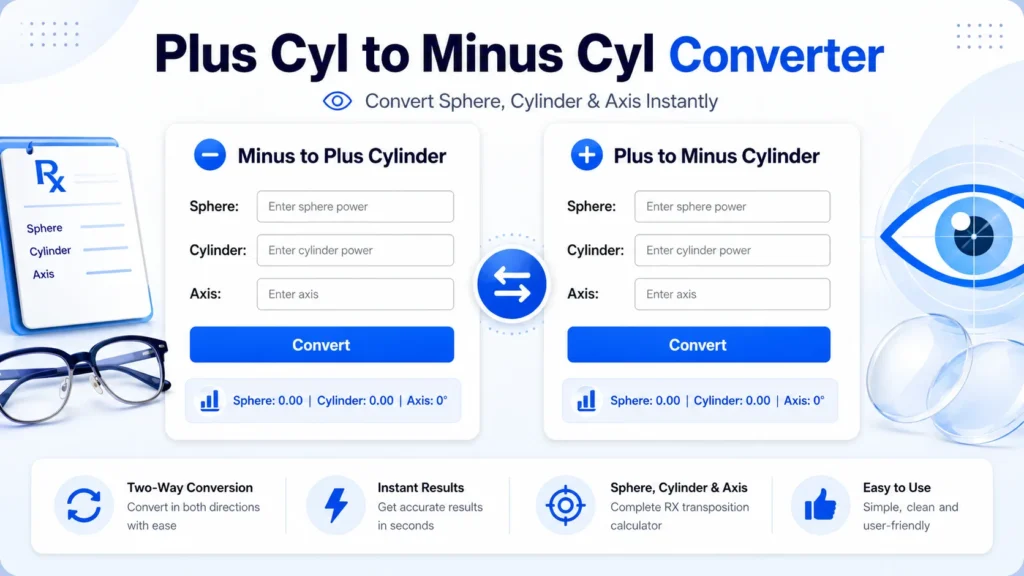
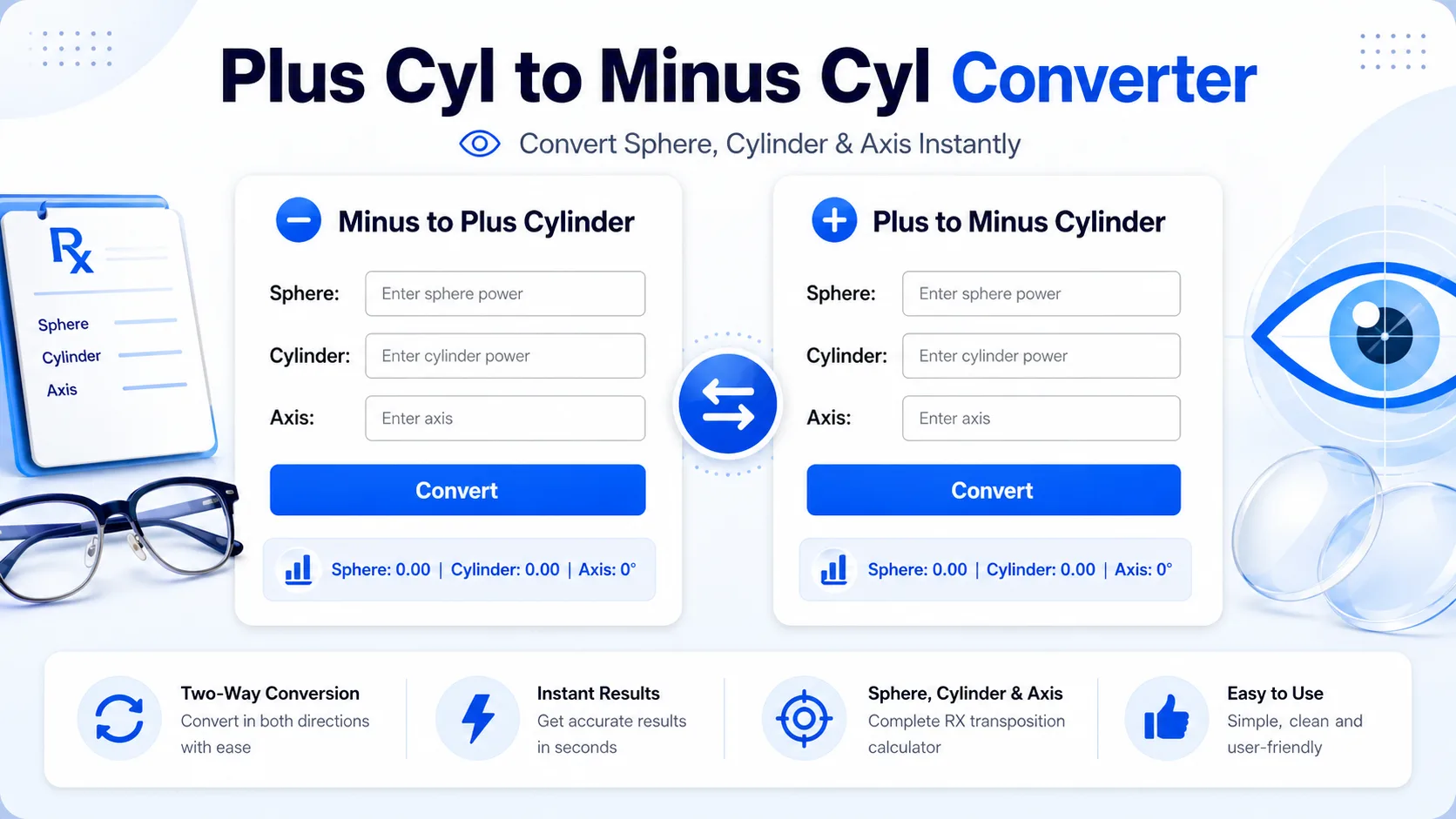
In the screenshot, the tool has two side-by-side conversion boxes. The left box is labeled Minus to Plus Cylinder, and the right box is labeled Plus to Minus Cylinder. Both sections include input fields for Sphere, Cylinder, and Axis, followed by a blue Convert button and a result area.
This means you can use the same page to convert plus cyl to minus cyl, convert minus cyl to plus cyl, transpose RX values, and check prescription notation quickly.
What Do Sphere, Cylinder, and Axis Mean?
Sphere
Sphere, often written as SPH, shows the main lens power in an eyeglass prescription. It is used to correct nearsightedness or farsightedness.
A minus sphere value usually relates to myopia correction, while a plus sphere value usually relates to hyperopia correction. During RX transposition, the sphere value changes because it is combined with the cylinder value.
Cylinder
Cylinder, often written as CYL, shows the amount of astigmatism correction. It can be written as a plus cylinder or a minus cylinder, depending on the prescription format.
Plus cylinder and minus cylinder forms can describe the same optical correction, but the written values look different after transposition.
Axis
Axis shows the direction of astigmatism correction in degrees. It is usually written from 1° to 180°.
When you convert plus cylinder to minus cylinder or minus cylinder to plus cylinder, the axis is rotated by 90 degrees to keep the prescription optically equivalent.
How to Use the Plus Cyl to Minus Cyl Converter
Convert Plus Cylinder to Minus Cylinder
- Use the right converter panel labeled Plus to Minus Cylinder.
- Enter the sphere power in the Sphere input field.
- Enter the cylinder power in the Cylinder input field.
- Enter the axis value in degrees in the Axis input field.
- Click the blue Convert button.
- Read the converted result in the result box showing Sphere, Cylinder, and Axis.
Convert Minus Cylinder to Plus Cylinder
- Use the left converter panel labeled Minus to Plus Cylinder.
- Type the sphere value in the Sphere field.
- Type the cylinder value in the Cylinder field.
- Type the axis value in the Axis field.
- Click the blue Convert button.
- Check the result area for the transposed sphere, cylinder, and axis values.
The visible result area is helpful because it groups the final prescription values together in one line, such as Sphere, Cylinder, and Axis.
Plus to Minus Cyl Formula
To convert plus cylinder to minus cylinder, use the standard lens transposition formula.
New Sphere = Sphere + Cylinder
New Cylinder = Cylinder × -1
New Axis = Axis ± 90°
After changing the axis, keep the final axis within the normal 1° to 180° range. If the new axis is greater than 180°, subtract 180. If the result becomes 0°, it is commonly written as 180°.
Minus to Plus Cyl Formula
The same RX transposition formula works when converting minus cylinder to plus cylinder.
Plus Form Sphere = Sphere + Minus Cylinder
Plus Form Cylinder = Change -CYL to +CYL
Plus Form Axis = Axis ± 90°
This keeps the same optical correction but rewrites the prescription in the opposite cylinder notation.
Key Features
Two-Way Cylinder Conversion
The tool supports both plus to minus cyl conversion and minus to plus cyl conversion. This makes it useful for users who need either prescription format.
Separate Sphere, Cylinder, and Axis Fields
Each converter panel has clear input fields for sphere, cylinder, and axis. This helps users enter each prescription value in the correct place instead of combining values manually.
Dedicated Convert Buttons
Each side has its own blue Convert button. This makes the conversion direction clear and helps reduce mistakes when switching between plus and minus cylinder formats.
Instant Result Box
The result box displays the converted prescription values together: Sphere, Cylinder, and Axis. This makes the final RX easy to read, compare, or copy into notes.
Supports Common RX Transposition Needs
You can use the tool as a cyl converter calculator, prescription transpose calculator, optical transposition calculator, or glasses RX converter when working with spectacle prescription notation.
Why Use This RX Transpose Calculator?
Manual prescription transposition can be confusing because three values change at the same time. The sphere is recalculated, the cylinder sign is reversed, and the axis changes by 90 degrees.
This calculator saves time and reduces the chance of missing a step. It is especially useful for optometry students, opticians, eyeglass technicians, optical labs, and users comparing prescriptions from different sources.
It also helps when one system asks for minus cylinder form while another prescription is written in plus cylinder form. Instead of guessing, you can enter the values and check the equivalent notation.
Practical Example: Convert Plus Cyl to Minus Cyl
Suppose the original prescription is:
+2.00 / +1.00 × 45°
Step 1: Add sphere and cylinder.
+2.00 + +1.00 = +3.00
Step 2: Change the cylinder sign.
+1.00 becomes -1.00
Step 3: Rotate the axis by 90 degrees.
45° + 90° = 135°
The converted prescription is:
+3.00 / -1.00 × 135°
This is the same optical correction written in minus cylinder form.
Practical Example: Convert Minus Cyl to Plus Cyl
Suppose the original minus cylinder prescription is:
-4.00 / -1.50 × 180°
Step 1: Add sphere and cylinder.
-4.00 + -1.50 = -5.50
Step 2: Change the cylinder sign.
-1.50 becomes +1.50
Step 3: Rotate the axis by 90 degrees.
180° – 90° = 90°
The converted prescription is:
-5.50 / +1.50 × 90°
Plus Cylinder vs Minus Cylinder
Plus cylinder and minus cylinder are two different ways to write astigmatism correction. One uses a positive cylinder value, and the other uses a negative cylinder value.
Neither format is automatically better. They are notation styles. Different clinics, optical labs, training systems, and software tools may prefer different formats.
When converted correctly, plus cylinder and minus cylinder versions can describe the same lens correction. The important part is that the sphere, cylinder, and axis must all be transposed together.
Why Does the Axis Change by 90 Degrees?
The axis changes because reversing the cylinder sign changes the way astigmatism correction is described. To keep the same optical correction, the axis must rotate by 90 degrees.
This is one of the most common mistakes in manual RX transposition. Some users change the cylinder sign but forget to move the axis. That creates a different prescription and may not represent the same lens correction.
The converter helps by applying the axis change as part of the full transposition process.
Who Can Use This Tool?
This Plus Cyl to Minus Cyl Converter can help optometry students learn prescription transposition and check their manual calculations.
Opticians, optical assistants, and eyeglass technicians can use it when comparing prescription formats or entering values into systems that require a specific cylinder notation.
General users can also use it to understand why two prescriptions may look different but represent equivalent spectacle correction. However, final prescription decisions should always be confirmed by a qualified eye care professional.
Common Mistakes to Avoid
Changing Only the Cylinder Sign
A correct RX transpose does not only change +CYL to -CYL or -CYL to +CYL. You must also adjust the sphere and rotate the axis.
Forgetting the Axis Range
Axis values are usually written from 1° to 180°. If your new axis is above 180°, subtract 180. If it becomes 0°, write it as 180° in standard optical notation.
Entering the Wrong Conversion Side
Use the Plus to Minus Cylinder panel when your starting cylinder is positive. Use the Minus to Plus Cylinder panel when your starting cylinder is negative.
Using It as a Medical Diagnosis Tool
This calculator only changes prescription notation. It does not test vision, diagnose eye conditions, or decide whether a prescription is suitable for your eyes.
Helpful Tips
- Check the sign of the cylinder value before choosing the conversion direction.
- Enter the axis as a number from 1 to 180 whenever possible.
- Keep sphere and cylinder signs clear, such as +2.00 or -1.50.
- Use the result to compare notation, not to change the prescribed correction.
- Confirm final glasses or contact lens values with an optometrist, ophthalmologist, or optical lab.
Limitations
This tool is for spectacle prescription transposition only. It converts sphere, cylinder, and axis notation between plus cylinder and minus cylinder forms.
It does not check whether a prescription is correct, current, safe, or suitable for your eyes. It also does not replace a professional eye exam.
Contact lens prescriptions may require extra values such as base curve, diameter, lens brand, material, fitting evaluation, and sometimes vertex distance adjustment. Do not treat this tool as a complete contact lens prescription converter.
Accuracy depends on entering the correct sphere, cylinder, and axis values and choosing the correct conversion direction.
Conclusion
This Plus Cyl to Minus Cyl Converter helps you transpose eyeglass prescriptions between plus cylinder and minus cylinder formats. It uses the standard RX transposition method: add sphere and cylinder, reverse the cylinder sign, and rotate the axis by 90 degrees.
Use it when you need a quick cylinder conversion, want to check a manual calculation, or need to compare prescription notation in a clearer format.
FAQs
What is a Plus Cyl to Minus Cyl Converter?
A Plus Cyl to Minus Cyl Converter transposes an eyeglass prescription from positive cylinder notation to negative cylinder notation. It adjusts the sphere, changes the cylinder sign, and rotates the axis by 90 degrees.
How do you convert plus cyl to minus cyl?
Add the sphere and plus cylinder together, change the cylinder from positive to negative, and rotate the axis by 90 degrees. Keep the final axis between 1° and 180°.
How do you convert minus cyl to plus cyl?
Add the sphere and negative cylinder together, change the cylinder from negative to positive, and rotate the axis by 90 degrees. This gives the equivalent plus cylinder form.
What is RX transpose?
RX transpose means rewriting an optical prescription from plus cylinder to minus cylinder form, or from minus cylinder to plus cylinder form, while keeping the same optical correction.
Does transposing RX change the prescription?
It changes how the prescription is written, but it should not change the intended optical correction when done correctly. The sphere, cylinder, and axis values will look different.
Why does the axis change in cylinder conversion?
The axis changes by 90 degrees because the cylinder sign is reversed. The axis rotation keeps the astigmatism correction equivalent in the new notation.
Can I use this calculator for contact lenses?
This calculator is mainly for eyeglass prescription transposition. Contact lens prescriptions require additional fitting details, so confirm contact lens values with an eye care professional.
Useful Vision, Health & Measurement Tools
If you are using the Plus Cylinder to Minus Cylinder Converter, these related tools can help with health calculations, measurement conversions, and practical everyday calculators.
- Accutane Dosage Calculator – a related health calculator for body-weight-based dosage estimates.
- Water Intake Calculator – estimate daily hydration needs based on personal details and routine.
- Weight and Mass Unit Converter – convert body weight and mass values across common units.
- Online Ruler – measure cm, mm, and inches directly on screen for quick physical checks.