The tool also works in reverse. You can convert BTU/lb·°F to kJ/kg·K from the second converter box, which is useful for HVAC work, thermodynamics problems, heat transfer calculations, material data sheets, and engineering unit conversions.
Quick Answer
A kJ/kg·K to BTU/lb·°F converter converts specific heat capacity from kilojoules per kilogram per Kelvin to British thermal units per pound per degree Fahrenheit.
The main formula is BTU/lb·°F = kJ/kg·K × 0.239006.
For reverse conversion, use kJ/kg·K = BTU/lb·°F × 4.1868.
What Is This Heat Capacity Converter?
This heat capacity converter is an online tool that converts specific heat capacity values between kJ/kg·K and BTU/lb·°F. It helps you compare material heat capacity values when one source uses SI units and another source uses imperial units.
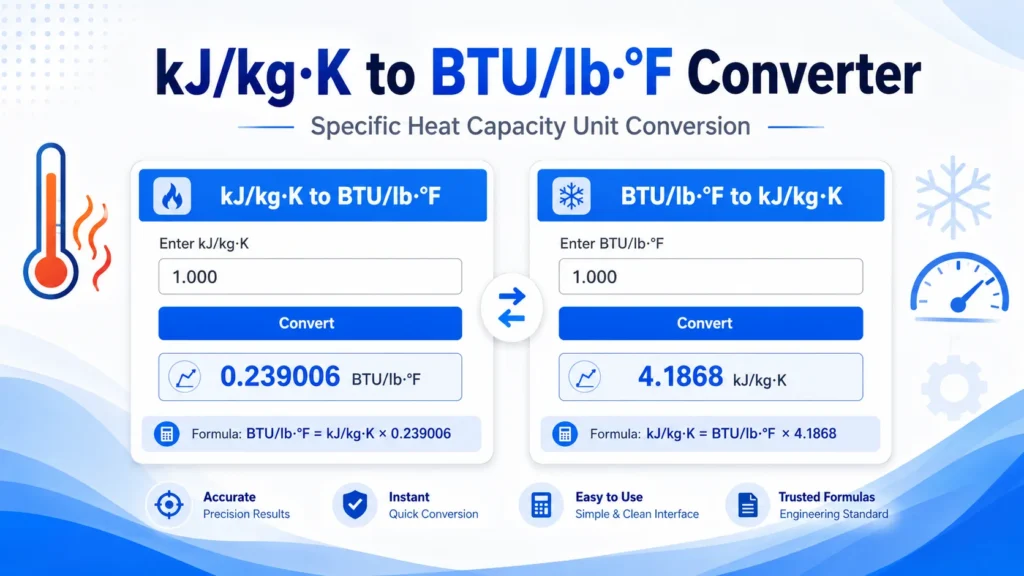
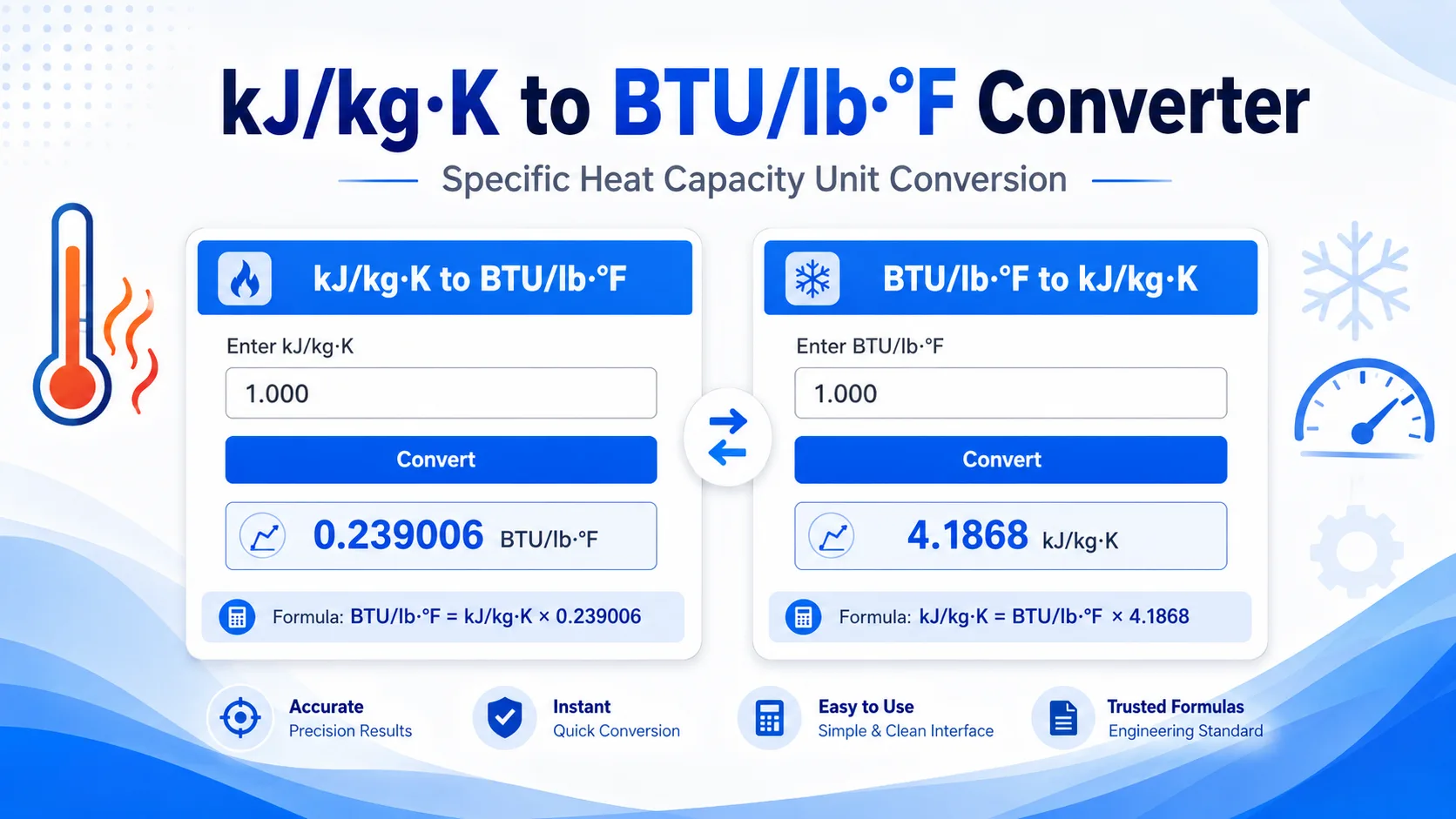
The screenshot shows two conversion panels. The left panel converts kJ/kg·K to BTU/lb·°F. The right panel converts BTU/lb·°F to kJ/kg·K. Each panel includes an input field, a blue Convert button, a result box, and a formula line below the result.
This tool is designed for specific heat capacity, not general energy conversion. That means it should be used when your unit includes a temperature interval, such as K, °C, °F, or °R.
What Does kJ/kg·K Mean?
kJ/kg·K means kilojoules per kilogram per Kelvin. It tells you how much heat energy is needed to raise the temperature of one kilogram of a material by one Kelvin.
For example, if a material has a specific heat capacity of 4.1868 kJ/kg·K, it needs about 4.1868 kilojoules of heat to raise 1 kilogram of that material by 1 Kelvin. Water is commonly close to this value, which is why it is often used as a reference in heat transfer problems.
What Does BTU/lb·°F Mean?
BTU/lb·°F means British thermal units per pound per degree Fahrenheit. It is an imperial specific heat capacity unit often seen in HVAC references, U.S. engineering tables, heat exchanger data, and older material property charts.
Many people search for terms like BTU/lBF to kJ/kgK or BTU lbf to kJ kgk. In this context, the correct meaning is usually BTU per pound mass per degree Fahrenheit, not pound-force. The tool uses the standard heat capacity unit BTU/lb·°F.
How to Use the kJ/kg·K to BTU/lb·°F Converter
Convert kJ/kg·K to BTU/lb·°F
- Go to the left converter box labeled kJ/kg·K to BTU/lb·°F.
- Enter your value in the input field with the placeholder Enter kJ/kg·K.
- Click the blue Convert button.
- Read the converted value in the result area shown in BTU/lb·°F.
- Use the formula shown below the result if you want to verify the calculation manually.
Convert BTU/lb·°F to kJ/kg·K
- Use the right converter box labeled BTU/lb·°F to kJ/kg·K.
- Enter the imperial heat capacity value in the field labeled Enter BTU/lb·°F.
- Click the blue Convert button.
- Check the result box to see the answer in kJ/kg·K.
- Review the displayed formula below the result for the reverse conversion factor.
The visible result boxes show the converted value clearly, so you do not need to manually rearrange formulas unless you want to check your work.
kJ/kg·K to BTU/lb·°F Formula
To convert kJ/kg·K to BTU/lb·°F, multiply the kJ/kg·K value by 0.239006.
BTU/lb·°F = kJ/kg·K × 0.239006
This formula is useful when your material data is listed in metric specific heat capacity units and you need the equivalent imperial value.
BTU/lb·°F to kJ/kg·K Formula
To convert BTU/lb·°F to kJ/kg·K, multiply the BTU/lb·°F value by 4.1868.
kJ/kg·K = BTU/lb·°F × 4.1868
This reverse formula is helpful when an HVAC document, U.S. engineering table, or equipment manual gives specific heat capacity in BTU/lb·°F and you need the SI value.
Key Features of This Converter
Two-Way Heat Capacity Conversion
The tool supports both convert kJ/kgK to BTU/lBF style searches and reverse BTU/lb F to kJ/kg K conversions. This saves time when switching between metric and imperial engineering references.
Simple Input Fields
The visible input fields let you enter values directly. You can type values such as 1, 4.187, 7.5, or 45 without setting up a spreadsheet or manual calculator.
Clear Convert Buttons
Each panel has its own blue Convert button. This makes it easy to choose the correct direction and reduces the chance of using the wrong conversion formula.
Instant Result Area
The result box displays the converted value with the correct unit, such as BTU/lb·°F or kJ/kg·K. This helps users quickly copy or record the result for homework, reports, or engineering notes.
Formula Display
Each converter panel shows the formula under the result. This is useful for students, engineers, and technical users who want to understand how the answer was calculated.
Why Use This kJ/kg·K to BTU/lb·°F Converter?
Manual heat capacity conversion can be easy to get wrong because the unit combines energy, mass, and temperature difference. This converter reduces manual work and helps you keep calculations consistent.
It is especially useful when comparing material properties from different sources. For example, one table may show specific heat in kJ/kg·K, while another shows BTU/lb·°F. Converting the values into the same unit makes comparison easier.
The tool also helps avoid common mistakes such as mixing kJ/kg with kJ/kg·K or reading BTU/lb as a plain energy-per-mass unit. For heat capacity, the temperature part of the unit matters.
Practical Example
Suppose you have a specific heat value of 4.187 kJ/kg·K and want to convert it to BTU/lb·°F.
Use the formula:
BTU/lb·°F = kJ/kg·K × 0.239006
Now multiply:
4.187 × 0.239006 = 1.0007 BTU/lb·°F
So, 4.187 kJ/kg·K is approximately 1.0007 BTU/lb·°F. This is close to the common specific heat value of water in imperial units.
Common Conversion Values
The table below gives quick reference values for common kJ/kg·K to BTU/lb·°F conversions.
| kJ/kg·K | BTU/lb·°F |
|---|---|
| 0.5 | 0.119503 |
| 1 | 0.239006 |
| 2 | 0.478012 |
| 4.187 | 1.0007 |
| 7.5 | 1.792545 |
For reverse lookup, 1 BTU/lb·°F is approximately 4.1868 kJ/kg·K.
Who Can Use This Tool?
This converter is useful for students solving thermodynamics and heat transfer problems. It helps them check unit conversions quickly without manually applying conversion factors every time.
Engineers and HVAC professionals can use it when comparing data from international equipment manuals, heating and cooling calculations, refrigerant references, and material property tables.
Researchers, teachers, technical writers, and general users can also use it when they need to explain or compare specific heat capacity values in metric and imperial units.
When Should You Use This Converter?
Use this tool when your value includes a temperature interval, such as kJ/kg·K, kJ/kg·°C, BTU/lb·°F, or BTU/lb·°R.
Do not use it for plain kJ/kg to BTU/lb conversion unless the value is specifically about heat capacity with a temperature difference. Plain kJ/kg is normally specific energy, not specific heat capacity.
Common Mistakes to Avoid
Ignoring the Temperature Unit
Do not treat kJ/kg·K as the same as kJ/kg. The “per Kelvin” part means the value changes with temperature difference and belongs to specific heat capacity.
Confusing lb and lbf
Searches like BTU/lBF to kJ/kgK are common, but specific heat capacity uses pound mass in practical unit notation. The correct converter unit is BTU/lb·°F.
Using the Wrong Direction
Use the left panel for kJ/kg·K to BTU/lb·°F. Use the right panel for BTU/lb·°F to kJ/kg·K. Switching the direction will give the wrong result.
Rounding Too Early
If you are using the result in another calculation, keep a few decimal places until the final step. Early rounding can cause small errors in longer engineering calculations.
Helpful Tips for Better Results
- Check that your input value is a specific heat capacity value, not a plain energy value.
- Use decimal values carefully, especially for small material property values.
- Compare the result with known reference values when possible.
- Use the displayed formula to verify the conversion direction.
- For J/kg·K values, divide by 1000 first to convert J/kg·K into kJ/kg·K.
Limitations of the Tool
This converter only changes the unit of a specific heat capacity value. It does not measure a material’s actual heat capacity, identify materials, or adjust values for temperature, pressure, purity, or composition.
The result depends on the value you enter and the conversion direction you choose. If the input value is incorrect, incomplete, or in the wrong unit, the converted answer will also be incorrect.
Specific heat capacity can vary with temperature and material condition. For design, safety, academic grading, or professional engineering work, always confirm the original material property from a trusted textbook, standard, manufacturer data sheet, or engineering reference.
Conclusion
This kJ/kg·K to BTU/lb·°F converter gives you a fast way to convert specific heat capacity values between metric and imperial units. It includes two-way conversion, clear input fields, separate Convert buttons, visible result boxes, and formulas for checking the calculation.
Use it whenever you need to compare heat capacity data, solve thermodynamics problems, work with HVAC values, or convert material property units without doing the math manually.
FAQs
How do you convert kJ/kg·K to BTU/lb·°F?
Multiply the kJ/kg·K value by 0.239006. For example, 1 kJ/kg·K equals 0.239006 BTU/lb·°F.
How do you convert BTU/lb·°F to kJ/kg·K?
Multiply the BTU/lb·°F value by 4.1868. For example, 1 BTU/lb·°F equals about 4.1868 kJ/kg·K.
Is kJ/kg·K the same as kJ/kg·°C?
For temperature difference, 1 Kelvin change is equal in size to 1 degree Celsius change. Because of that, kJ/kg·K and kJ/kg·°C often have the same numeric value in specific heat calculations.
Is BTU/lb·°F the same as BTU/lb·°R?
For temperature intervals, a degree Fahrenheit and a degree Rankine have the same size. That is why BTU/lb·°F and BTU/lb·°R are often numerically equivalent for specific heat capacity.
Can I convert J/kg·K to BTU/lb·°F?
Yes. First divide the J/kg·K value by 1000 to convert it into kJ/kg·K. Then multiply the result by 0.239006.
Is kJ/kg to BTU/lb the same as kJ/kg·K to BTU/lb·°F?
No. kJ/kg to BTU/lb is a specific energy conversion. kJ/kg·K to BTU/lb·°F is a specific heat capacity conversion because it includes temperature difference.
Why do some conversion factors look slightly different?
Small differences usually come from rounding or from different BTU definitions. For normal homework, HVAC, and general engineering use, the displayed rounded factors are usually enough.
Useful Heat Capacity & Converter Tools
If you are using the kJ/kg·K to BTU/lb·°F Converter, these related tools can help you with engineering units, material values, process calculations, and common metric-to-imperial conversions.
- Kg/hr to GPM Converter
– convert mass flow rate to volume flow rate for fluid and engineering calculations. - 4–20mA Calculator
– scale current loop signals into process values for pressure, temperature, flow, and level instruments. - mg/kg to PPM Converter
– convert mass-based concentration values between milligrams per kilogram and parts per million. - Weight and Mass Unit Converter
– convert between common mass units used in formulas, data sheets, and unit conversion work.